



If you’ve been trying to figure out which one your business actually needs, you’re not alone. And the answer matters more than most people realize.
You’ve hit a growth ceiling. You know you need outside help. So you start Googling.
Business coach. Fractional CMO. Fractional COO. Growth Infrastructure Partner. Maybe you’ve also seen consultant, OBM, EOS Integrator, and a dozen other titles that all sound vaguely like “person who helps your business run better.”
The problem? These roles are genuinely different. Hiring the wrong one doesn’t just waste money. It solves the wrong problem, which often makes the real one harder to see.
Here’s a plain-language breakdown of what each role actually does, who it’s for, and when you need it.
First, why does this matter?
Most established businesses don’t fail because the owner lacks ideas or drive. They stall because three things are working in silos: strategy, marketing, and operations. Each one is getting some attention, but none of them are connected to each other.
The result? Marketing builds something operations can’t deliver. Operations creates processes that don’t match how customers buy. Strategy shifts, but nothing downstream gets the memo.
And the business owner ends up being the translator between all three.
When you bring in outside help, the question isn’t just “what do I need help with?” It’s “where is the actual disconnect?”
The answer shapes everything.
The Business Coach or Consultant
What they do:
A business coach or consultant helps you think. They work with you on direction, decisions, offers, positioning, and priorities. They ask good questions, offer an outside perspective, and give you a clearer picture of where you are and where you should be going.
This is where most business owners start when they hit a ceiling, and for good reason. When things feel murky, clarity is genuinely valuable.
What they’re great at:
- Helping you get clear on direction and strategy
- Identifying what’s working and what isn’t from the outside
- Working through decisions you’ve been too close to see clearly
- Giving you a framework for thinking about your business
When you need one:
You’re not sure where to focus. Your offers feel unclear. You need someone to pressure-test your thinking and help you set priorities. You need direction before you can take action.
Where they typically stop:
The limitation isn’t the role itself. It’s that strategy without implementation still leaves execution on you. You walk away with clarity and a plan, but building it out is still your job. For a lot of business owners, that gap between “I know what to do” and “it’s actually built and running” is exactly where things stall.
The Fractional CMO
What they do:
A Fractional CMO is a part-time marketing executive. They step into a marketing leadership role, typically directing a team, setting strategy, and overseeing campaigns, brand, and demand generation. Think: senior marketing brain, without the full-time salary.
What they’re great at:
- Leading an existing marketing team that needs direction
- Setting a marketing strategy and making sure it gets executed
- Bridging the gap between the CEO and a marketing department that’s lost its way
- Owning the marketing function at an executive level
When you need one:
You have a marketing team (even a small one) that needs leadership. You’re spending on marketing but lack the senior expertise to guide it. You need someone to own the marketing function, not just consult on it.
Where they typically stop:
Most Fractional CMOs stay in their lane: marketing. They’re not typically touching your operations, your fulfillment processes, or how your marketing connects to what actually happens after someone buys. And they usually direct rather than build. They’re executives, not implementers.
The Fractional COO
What they do:
A Fractional COO is a part-time operations executive. They focus on the internal workings of the business: team structure, processes, systems, scalability, and execution. Where a CEO focuses on where the business is going, the COO focuses on how it gets there.
What they’re great at:
- Cleaning up operational chaos in a scaling company
- Building or restructuring teams and accountability systems
- Creating the infrastructure for consistent delivery
- Managing the leadership team and keeping execution on track
When you need one:
Your business has grown to a point where operations are genuinely complex. You have a team, and someone needs to run it. You’re the CEO and you’re drowning in internal problems that are pulling you away from the business itself.
Where they typically stop:
A Fractional COO isn’t your marketing person. They’re not building your funnels, thinking about your customer acquisition strategy, or connecting your operational systems to how customers experience your brand. They run the machine. They don’t typically design it from the outside in.
The Growth Infrastructure Partner
What they do:
The title says exactly what it is. A Growth Infrastructure Partner builds the infrastructure your business needs to grow: the strategy, the marketing systems, and the operational processes, designed to work together rather than in silos.
Where other roles focus on one function, a Growth Infrastructure Partner works across all three. The job isn’t to lead your marketing team or run your operations. It’s to build the connective tissue between them so growth becomes something your business does systematically, not something you personally hold together.
What they’re great at:
- Diagnosing where the real disconnects are (not just the symptoms)
- Building the infrastructure that connects strategy, marketing, and operations
- Taking work off the owner’s plate across multiple functions at once
- Creating systems and assets the business owns permanently
- Serving as the single point of coordination so the owner stops being the translator
When you need one:
You’re a smaller or mid-sized business where the problem isn’t “my marketing team needs leadership” or “my ops department is out of control.” The problem is that things don’t connect. Marketing is saying one thing, operations is doing another, and you’re somewhere in the middle trying to make it all work.
You don’t have the team size to justify a CMO and a COO. You need someone who can see across all three areas and build the bridges between them.
Where they typically stop:
A Growth Infrastructure Partner isn’t managing your team full-time, running your paid ads, or handling execution-heavy ongoing work like social media. The focus is on infrastructure: the systems, the strategy, and the connections between functions. Not the daily operational management.
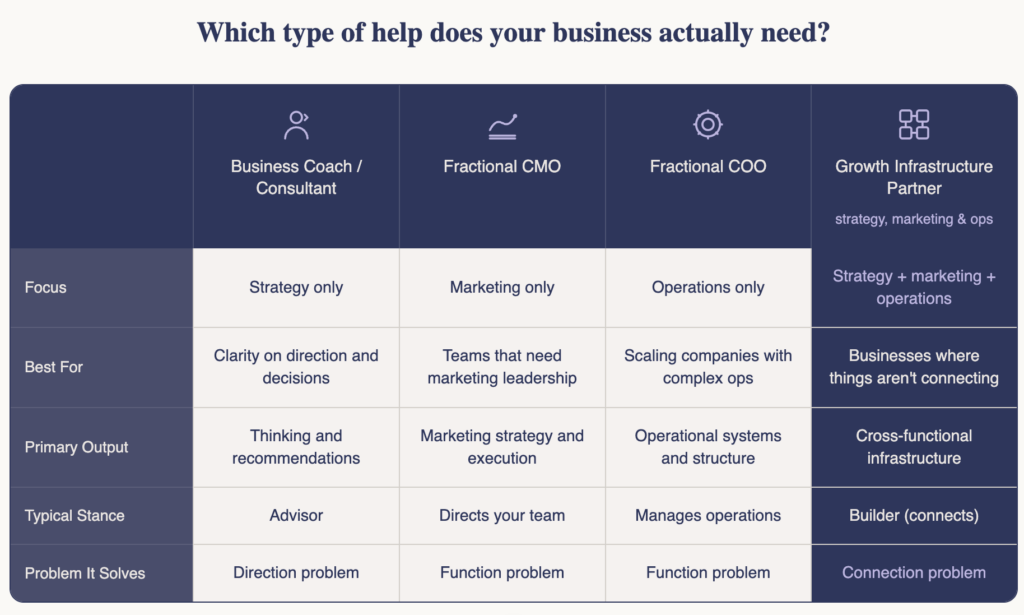
The honest question to ask yourself
Before hiring any of them, get clear on this: what kind of problem are you actually solving?
A direction problem means things feel murky. You’re not sure where to focus, what to prioritize, or whether you’re even working on the right things. A business coach or consultant is the right call here. You need clarity before you can take meaningful action.
A function problem means one area is genuinely broken or missing. Your marketing is weak. Your operations are chaos. You need an expert in that specific domain to come in and fix it. That’s where a Fractional CMO or COO earns their place.
A growth infrastructure problem means the systems, strategy, and operations required for predictable, sustainable growth either don’t exist yet, aren’t built correctly, or aren’t working together. This isn’t just about connecting departments. It’s about building the whole foundation: the right offers positioned to the right market, the marketing that brings in the right clients, and the operations that deliver on what you promised, designed to work as one system rather than three separate efforts.
A Growth Infrastructure Partner comes in, diagnoses the full picture across all three areas, and builds what’s missing, fixes what isn’t working, and connects what needs to be connected. The result isn’t just a better-linked business. It’s a business that grows systematically without you holding it all together.
Here’s the part that matters most: a lot of business owners with a growth infrastructure problem keep hiring for a direction problem. They’ve worked with coaches and consultants for years, gotten plenty of clarity, and are still stuck. Not because the coaching was bad, but because clarity alone doesn’t build infrastructure.
If you’ve had the strategy conversations and you still feel like you’re holding everything together, the problem probably isn’t your thinking. It’s that the infrastructure required to grow without you in the middle hasn’t been built yet.
One more thing
If you’re still figuring out which one fits, that’s usually a sign worth paying attention to. Clarity on the problem comes before clarity on the solution. A good diagnostic conversation with any of these people should help you figure out not just whether they’re a fit, but whether you’re even solving the right problem.
That question is always worth asking first.
Christa Potter is the founder of Scaling with Strategy, a consulting practice that builds the infrastructure connecting strategy, marketing, and operations for established service businesses. She works with business owners whose offer works, whose clients are happy, and who have hit a ceiling they can’t break through alone.




+ show Comments
- Hide Comments
add a comment